

There is a strange polarization happening in the marketing industry right now.
Some agencies are selling a future where artificial intelligence replaces marketing teams entirely. Others are warning that AI threatens creativity and will erode the strategic thinking that makes great marketing possible.
Both positions miss the point.
At Mad Fish and Grady Britton, we believe AI is neither the replacement for marketing nor the enemy of creativity. We are being actively curious and tackling this new future with intention knowing that our leadership will help propel our clients and our work forward as we have for our collective 70 years.
Our vision within the agency: AI is the acceleration layer of modern Brand + Demand marketing.
With AI, our team is activating ideas faster, getting to the heart of digital insights earlier, and testing ideas on a larger scale. This allows our very human strategy, judgment, and cultural understanding to shine, providing the layer of confidence and accountability clients rely on.
That distinction matters. It matters to us as an agency, and it matters to ambitious brands as we move into this AI revolution.
The Real Role of AI in Modern Marketing
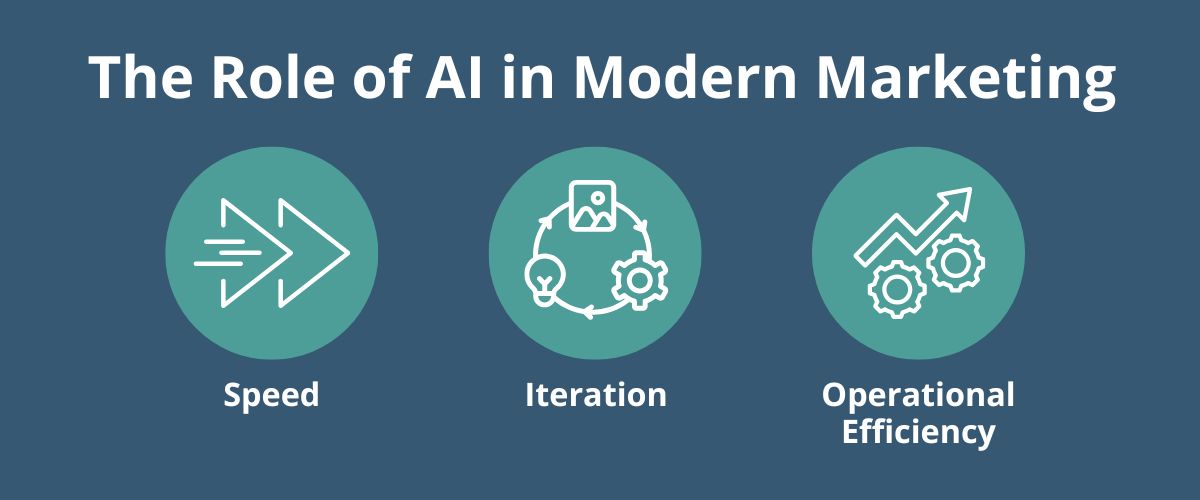
AI is incredibly good at three things that matter in performance marketing environments:
Speed: AI can process enormous datasets, summarize research, and identify patterns in minutes that might take humans hours. Our performance team has evolved our analytics capabilities using AI and has seen our time in the minutiae reduced. We are getting marketing managers’ answers and recommendations faster.
Iteration: AI-powered tools allow agencies to assess variations faster than ever before. Our digital creative team has been effectively scaling clients’ ad creative testing programs and conducting more iterations by leveraging its computational skills to review data that informs our team’s decisions.
Operational Efficiency: AI can automate workflows, accelerate research, and streamline production processes so teams spend more time on strategic work. With less time in spreadsheets and more time on collaboration, we are better prepared to dive into the nuance of a client’s needs and potential opportunities.
Our internal approach to AI reflects this simple philosophy – AI should help us service performance programs faster. It should not decide where we should go.
Where Human Strategy Still Wins
Marketing has never been purely analytical. The best campaigns come from understanding culture, emotion, human motivations, and the nuanced dynamics of brand perception. Those are not computational problems. They are human insight problems.
That’s why we have chosen to explicitly state in our AI Policy that AI should enhance human creativity and strategic thinking, never replace it.
For example, within our Brand Strategy practice we may use AI to:
- Supplement market research
- Identify emerging cultural trends
- Synthesize consumer insights
- Audit positioning and messaging
But the strategic decisions around brand narrative, how to position that narrative, and the concepts that will support it should remain human-led. This means group sessions with key stakeholders, focus groups and data collection with your customers, dynamic working sessions to get to the heart of the nature of what a brand is and has to offer. Authentic brand development requires cultural understanding and empathy that machines simply do not possess.
In a landscape increasingly filled with machine-generated content, authenticity isn’t just a creative principle. Authenticity is what consumers are demanding. Getty Images’ 2024 global study of over 30,000 consumers found that 98% agree authentic images and videos are pivotal to establishing trust, and that people feel less favorably toward brands using AI-generated visuals to depict real people or products. AI can surface insights and accelerate production, but it cannot replicate the cultural empathy that makes a brand feel genuinely human.
Why This Approach Differentiates Us
The agency landscape around AI is still evolving (too fast I might add). But broadly speaking, our leadership team sees two common approaches emerging.
The AI Hype Model
Some agencies position AI as a way to replace human marketers entirely. They promise instant content generation, automated strategy, and “fully AI-driven marketing.” The problem we are seeing emerge is these agencies are creating stale and rote campaigns, clone-like imagery and messaging, and a lack of humanity in the final pieces. Completed work is replacing good work and resulting in a glut of detached content that customers quickly see and forget.
The consequences of this approach are already showing up in consumer behavior. A 2024 study by Yahoo and Publicis Media found that 72% of consumers believe AI makes it difficult to determine what content is truly authentic. When audiences are already primed to distrust, flooding the market with AI-generated content isn’t a growth strategy. It’s a credibility risk.
The AI Fear Model
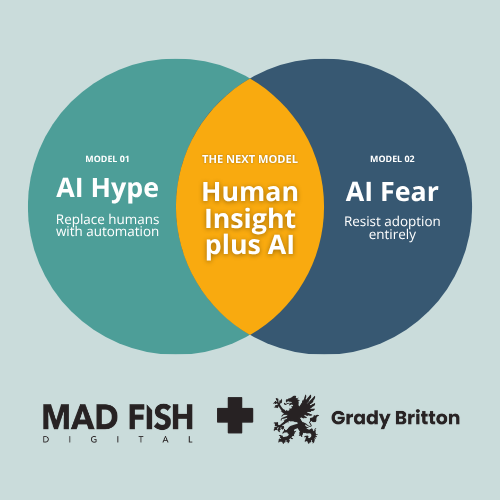 Other agencies deeply want to resist AI adoption altogether, positioning it as a threat to creativity and strategic thinking. The reality is all modern marketing platforms from Google Ads to Meta already rely on machine learning and the investment and adoption of AI is not trending toward fad. There is a real risk of becoming obsolete and losing to competition if AI is ignored. We are in an AI revolution and it is our place as agencies to help navigate the future of marketing into this very real future.
We’re Not Choosing a Side. We’re Building the Next Model.
Neither of these approaches reflects the reality of where marketing is going. We believe the future belongs to agencies willing to experiment. Our team has been given the mandate to explore how AI can elevate our work and improve performance for our current and future clients while maintaining human insight and cultural understanding.
Embracing curiosity and getting real on what we add that is special, human, and differentiating in everything we do is how we build a model to emulate. This mindset allows us to push marketing forward without losing what makes great brands possible in the first place: human creativity, empathy, and judgment.
The Ethical Dimension of AI in Marketing
As a B Corp-certified agency, we treat AI as both a technological tool and an ethical responsibility. We developed our AI philosophy to ensure that innovation never comes at the expense of trust.
It’s important that our team has clear guidelines to help navigate this uncertain road ahead. Our focus is on protecting clients, audiences, and creative integrity, in all things we do, including:
Human oversight of all AI-assisted work
All AI-generated outputs must be reviewed, edited, and approved by subject matter experts before delivery. It is only with human oversight and input do we keep a brand’s unique voice and position.
Protection of confidential information
Client-sensitive data is never input into third-party AI platforms without explicit written consent. The nature of AI and data privacy is yet unknown. We have helped clients navigate CCPA, GDPR, HIPAA, and W3C compliance, and we see AI regulation as the same opportunity to keep clients informed and compliant.
Transparency in AI usage
Clients are informed that AI may be used as part of the agency’s workflow and may request details about how it supports specific deliverables. We never want to obfuscate our work or how the data is collected and decisions are being made. That is the foundation of trust and our promise to clients.
These guardrails ensure AI enhances our work without compromising data security, intellectual property, or brand authenticity. We are approaching AI the same way we treat any powerful tool – with curiosity and responsibility.
The Future of Marketing Isn’t AI vs Humans
The future belongs to teams that combine both. AI isn’t done reshaping marketing as we have known it for the last 50 years. Campaign testing will continue to accelerate. Audience insights will deepen. More capabilities and use cases will be added. More regulations will be put in place. Business operations will fundamentally change.
But the brands that win – the brands that gain customers, keep customers and make an impact in the world – will still be those built on insight, creativity, empathy, and strategic thinking.
Those remain profoundly human capabilities.