
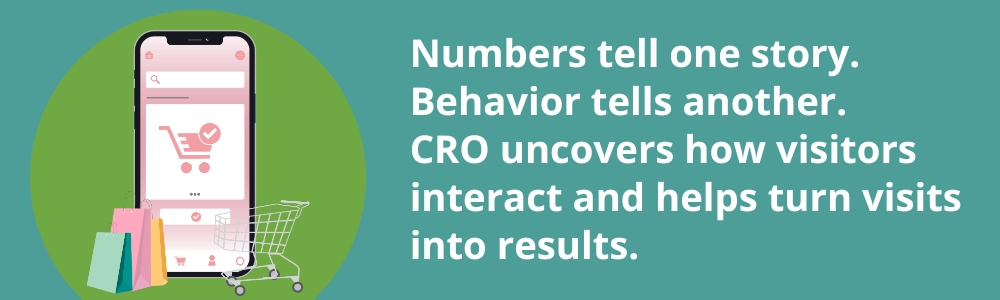
You’re investing real time and budget into driving traffic to your website, and at first glance, the numbers may look encouraging. But when conversions don’t keep pace with that effort, it often signals an opportunity to learn more about how visitors engage once they arrive.
Conversion rate optimization focuses on understanding that behavior and improving the experience so more visitors take action.
Do You Need a CRO Audit? Key Signs to Look For
If any of these sound familiar, conversion rate optimization should be on your roadmap. CRO helps you turn more of your existing traffic into meaningful actions, uncover hidden opportunities, and ensure your site works as hard as your marketing does.
High Traffic, Low Conversions
- “We’re getting a lot of traffic, but not enough leads or sales”
- Analytics show high traffic but poor conversion rates
- ROI isn’t matching ad spend
High Abandonment Rates
- Visitors add items to their cart but don’t complete purchases
- Form abandonment and checkout drop-offs
- Users leave before taking any action
Unclear User Journeys
- “Users seem confused about what to do next”
- High bounce rates with low page depth
- Navigation issues or poor mobile experience
Post-Redesign Issues
- “Our conversions dropped after the redesign”
- New site isn’t performing as expected
- Lost features or functionality impacting conversions
New Product or Service Launches
- Launching something new and want to optimize from day one
- Need to understand how users interact with new offerings
- Want data-driven insights before scaling spend
What Conversion Rate Optimization Really Means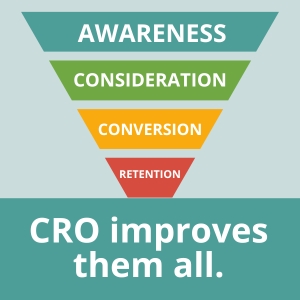
Imagine visitors arriving on your website. Some browse your products, others read your content, and a few complete a purchase or fill out a form.
Conversion rate optimization is the process of making it easier for more of those visitors to take meaningful actions across every stage of their journey. CRO does not just improve checkout pages or contact forms; it enhances the entire experience, from discovery to decision.
The math is simple. If 1,000 visitors come to your site and 10 convert, your conversion rate is 1 percent. By testing, analyzing, and refining each step of the journey, CRO can increase that percentage without spending more to drive additional traffic.
Why it matters: Customer acquisition costs are rising and paid advertising is becoming more expensive. Optimizing the visitor experience ensures that every click, scroll, and interaction works harder for your business, making CRO one of the most effective strategies for sustainable growth.
CRO Works Across Your Entire Funnel
Conversion rate optimization can improve every stage of your customer journey, helping you get more value from the traffic you’re already driving.
Awareness Stage
- Make landing pages more engaging to reduce bounce rates
- Test headlines and value propositions that capture attention
- Ensure a smooth mobile experience for first-time visitors
Consideration Stage
- Remove friction in discovering information
- Test content layouts to keep users engaged
- Optimize navigation to guide deeper exploration
Conversion Stage
- Streamline forms and checkout processes
- Test CTAs for clarity and placement
- Add trust signals and social proof
- Reduce cart abandonment
Retention & Loyalty Stage
- Enhance the post-purchase experience
- Optimize upsell and cross-sell opportunities
- Test email and account management flows
Each stage has its own conversion goals and requires a tailored optimization strategy. CRO works best when you think of it as improving the full journey, not just individual touchpoints.
What Makes CRO Effective
Data-Driven Analysis
Effective CRO isn’t about guesswork. It starts with understanding how visitors actually interact with your site:
- Analytics: Identify where visitors drop off and track conversion paths
- Heatmaps: See where users click, scroll, and spend time using tools like Microsoft Clarity or Hotjar
- Session Recordings: Watch real user behavior in action
- Form Analytics: Spot friction points in your conversion flows
A thorough CRO audit uncovers hidden barriers such as confusing navigation, slow page load times, unclear calls to action, and trust issues. By addressing these, you can make meaningful improvements that help more visitors take action.
User Behavior Insights
Data shows you what’s happening. Research helps you understand why.
- User Surveys and Feedback: Hear directly from your visitors
- Customer Interviews: Gain deeper insights into motivations and pain points
- On-Site Search Analysis: See what users are looking for and struggling to find
- Support Ticket Patterns: Identify common issues that affect conversions
Understanding visitor motivations, pain points, and objections helps guide meaningful optimization that actually improves results.
Strategic Testing
A/B testing allows you to validate hypotheses with real user behavior. Even small changes can lead to significant improvements:
- Headline rewrites
- Button color or copy updates
- Form simplification
- Social proof placement
- Page layout adjustments
Test one change at a time to see exactly what impacts performance and make data-driven decisions that move the needle.
Design & UX Optimization
Conversion-focused design removes friction and builds trust:
- Clear visual hierarchy
- Strategic CTA placement
- Mobile-responsive layouts (most traffic is mobile)
- Fast load times (use Google PageSpeed Insights)
- Trust signals: testimonials, security badges, guarantees
The CRO Process
Conversion rate optimization isn’t a one-time fix. It’s an ongoing cycle of testing, learning, and improving your website to help more visitors take action.
- Audit and Analysis
Start by understanding how your site is performing. Look at data, user behavior, and analytics to identify where visitors drop off and which areas have the biggest opportunity for improvement. - Hypothesis Development
Based on what you learn, form educated guesses about what changes could improve conversions. This could be anything from adjusting a headline to simplifying a form or clarifying a call to action. - Prioritization
Not all changes are equal. Focus first on improvements that are likely to have the biggest impact but take the least effort to implement. This ensures quick wins while planning for larger changes. - Testing and Implementation
Run controlled experiments, like A/B or multivariate tests, to see which changes actually move the needle. This helps you make decisions based on evidence, not assumptions. - Measurement and Iteration
CRO is a continuous cycle. Analyze the results, learn from what works and what doesn’t, and refine your site accordingly. Each round of testing gives you new insights for even better performance.
Real Impact: How CRO Moves the Needle
Conversion rate optimization isn’t abstract theory. It can change the trajectory of a business by helping you get more out of the traffic you already have.

Consider a B2C e-commerce site generating $500,000 in annual revenue with a 2 percent conversion rate. Increasing that to 3 percent through targeted testing and optimization could generate roughly $250,000 more in revenue without spending on additional ads. That growth comes from understanding what drives action, not just clicks.
The average cart abandonment rate is 70.22 percent. Optimizing checkout processes alone can recover a substantial portion of lost revenue and make a significant impact on overall sales.
Research shows that B2B sites with a one-second load time can see up to five times more conversions. Faster pages mean smoother experiences, higher engagement, and more leads. Conversion rate optimization helps improve load time by identifying slow pages, optimizing images, streamlining scripts, and removing technical friction. These changes may seem small, but they can have a big impact on conversions and the value you get from your existing traffic.
The businesses that succeed online are not always the ones with the largest ad budgets. They are the ones that focus on converting more of the traffic they already have through thoughtful testing, better user experience, and targeted optimizations.
Get More Value From Your Website Traffic
If you’re investing in traffic, the next step is making sure visitors take action once they arrive. A CRO audit shows where users drop off and highlights practical, data-driven improvements you can make to convert more visitors into customers.
Connect with our digital marketing agency to explore how thoughtful design and conversion rate optimization can help your business. We specialize in CRO for B2C, B2B, and e-commerce sites, combining user-focused design with data-driven testing to turn more visitors into customers.
About the author: Suu Ng is a Senior Graphic Designer specializing in CRO, using data-driven testing, user behavior analysis, and strategic design improvements to turn more visitors into customers.